Jeff Bezos' Blue Origin Plans to Literally Blast Asteroids Away From Earth, and We Have So Many Questions
In a move that sounds less like a space exploration initiative and more like a rejected Michael Bay screenplay, Blue Origin has officially announced plans to develop technology capable of deflecting asteroids away from Earth. While this might seem like the ultimate "just in case" insurance policy for humanity, the announcement has left scientists, space enthusiasts, and everyone with a functioning internet connection asking whether we're genuinely preparing for planetary defense or just funding the world's most expensive sci-fi cosplay project.
So What Exactly Is Blue Origin Proposing?
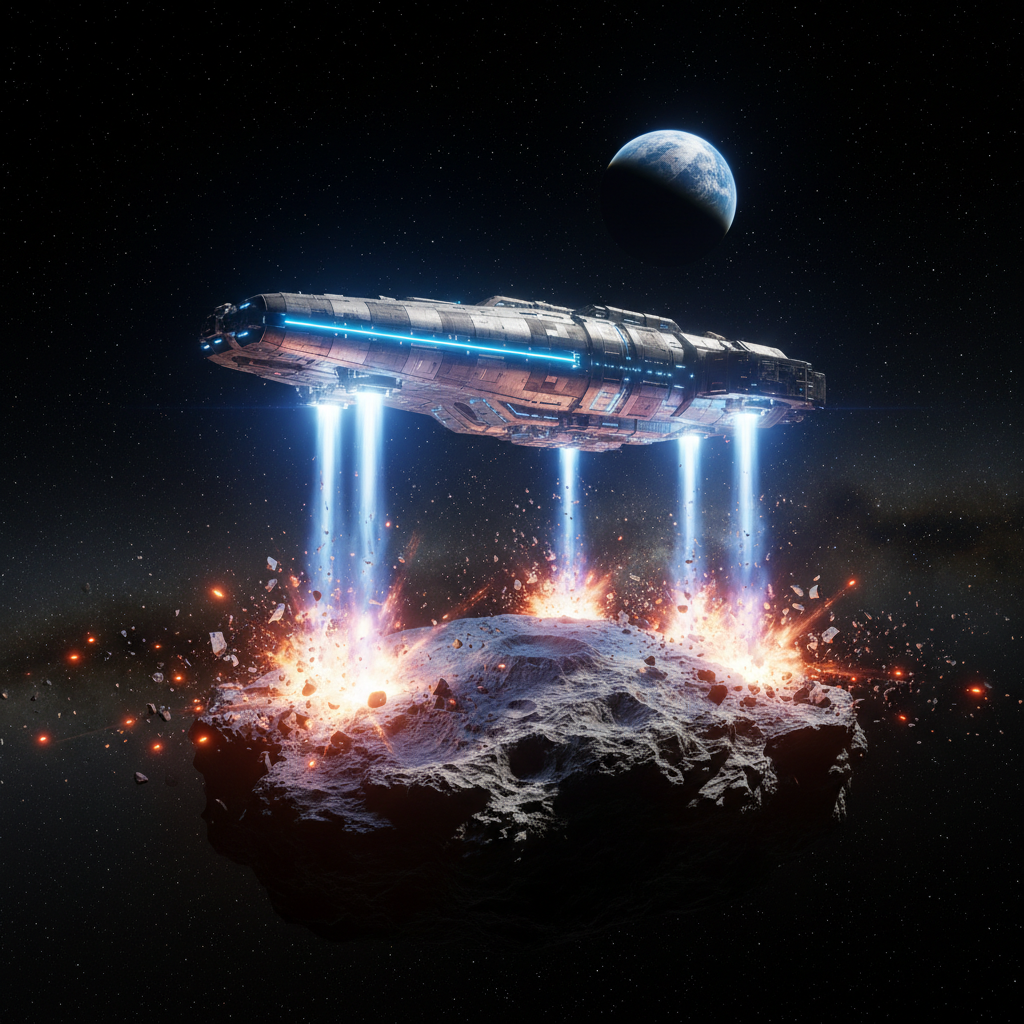
Blue Origin's newly unveiled concept involves using kinetic impact vehicles (fancy space terminology for "we're gonna hit asteroids really, really hard") to nudge potentially hazardous asteroids off their collision courses with Earth. The technology relies on a spacecraft intentionally ramming into an asteroid at high velocity, transferring momentum and altering the object's trajectory. Think of it like playing cosmic bumper cars, except the stakes involve the survival of entire civilizations and possibly your favorite pizza place.
The company has been surprisingly quiet about specific technical details, which is either a sign of proprietary innovation or a red flag that they're still working out whether their plan involves a lot of explosions and hope. What we do know is that the concept builds on NASA's DART (Double Asteroid Redirection Test) mission, which successfully demonstrated asteroid deflection in 2022 by smashing a spacecraft into the asteroid Dimorphos. If a government space agency can do it, Bezos apparently reasoned, then Blue Origin can definitely commercialize the heck out of it.
Why Now? The Asteroid Threat Assessment
Before you assume this is just billionaire excess, it's worth understanding that asteroid threats are genuinely legitimate concerns. NASA has identified over 28,000 near-Earth asteroids, and approximately 1,400 new ones are discovered every month. While the probability of a civilization-ending impact is relatively low in any given year, scientists agree that it's not a matter of if a dangerous asteroid will threaten Earth, but when. The dinosaurs would probably appreciate this level of preparation, had they been consulted.
Related: Best Password Manager 2026: Which One Actually Protects Your Passwords
Recent scientific studies have elevated the conversation around planetary defense from "interesting theoretical exercise" to "genuinely important infrastructure we should probably develop." The 2019 report from the National Academy of Sciences emphasized that asteroid defense technology needs to be developed decades before any actual threat emerges. Blue Origin's involvement suggests that private industry is finally taking the mission seriously, or at least recognizing that space defense could be extremely profitable.
The Questions Everyone's Actually Asking
How Much Is This Going to Cost?
Blue Origin hasn't released exact pricing, which is either refreshingly honest about the uncertainty or frustratingly typical of tech companies that announce ambitious projects without actual budgets. Developing, testing, and deploying asteroid deflection technology would require billions of dollars across multiple missions. For context, the DART mission cost approximately $325 million, and that was just a single kinetic impactor test. A full operational planetary defense system would likely cost orders of magnitude more.
What About International Coordination?
Here's where things get genuinely complicated. An asteroid threatening Earth doesn't care about national borders or corporate ownership structures. If Blue Origin successfully deflects an asteroid heading toward the Pacific Ocean, but the deflection causes it to threaten populated areas elsewhere, you've basically just created the world's first corporate-caused international incident. The United Nations has been working on planetary defense protocols, and involving private companies raises questions about accountability, decision-making authority, and who gets to play asteroid defense coordinator on a global scale.
Can We Actually Trust a Single Company With This?
Blue Origin bringing this technology to market represents a significant shift in how humanity approaches existential threats. Instead of government space agencies collaborating on this life-or-death mission, we're increasingly seeing private companies take leading roles. While companies like SpaceX have proven capable of advancing space technology dramatically, asteroid deflection is fundamentally different. This isn't about delivering satellites or tourists to space. This is about actively modifying objects in space in ways that could affect the entire planet. The margin for error is exactly zero.
Related: The Best Budget Wireless Earbuds for 2026: Premium Features Without the Price Tag
The Technical Challenges That Keep Scientists Awake
Beyond the philosophical questions lie some genuinely thorny technical problems. Different asteroids have different compositions, densities, and rotational characteristics. A kinetic impact approach that works perfectly on a solid metal asteroid might fail catastrophically on a loosely bound rubble pile. Scientists would need extensive reconnaissance missions to characterize potential threats before attempting deflection. Blue Origin hasn't detailed how they'd address these variabilities or what happens if their calculations are slightly off.
There's also the timing problem. If an asteroid is discovered only a few months before potential impact, a kinetic deflection mission might not provide sufficient trajectory change. The sooner you hit an asteroid, the more time gravity has to work the change into the object's path. This means that the ideal planetary defense system requires technology that can launch within weeks of threat identification. We're not quite there yet, and promising that capability is... optimistic.
Is This Actually a Good Idea or Cosmic Hubris?
The honest answer is that it's probably both. Developing asteroid defense technology is absolutely something humanity should pursue. The existential risk, though low probability, carries incredibly high stakes. Having multiple approaches and multiple organizations working on solutions provides redundancy and increases our chances of success when the real threat eventually emerges.
However, Blue Origin's announcement also reflects a troubling pattern where private companies rush to commercialize technologies before thoroughly exploring their implications. We're potentially talking about altering the trajectories of objects in space, and that deserves careful international deliberation, transparent safety protocols, and shared decision-making authority.
The Bottom Line
Blue Origin's plan to defend Earth from asteroids is simultaneously inspiring and unsettling. It's inspiring because humanity clearly needs multiple organizations and approaches to solve this problem, and commercial involvement can accelerate innovation. It's unsettling because we're cavaliar about weaponizing space technology and trusting a single company with planetary-scale consequences. The real question isn't whether Blue Origin can technically deflect an asteroid, but whether we're prepared for the geopolitical, legal, and ethical implications when they do.
For now, we can appreciate that someone with sufficient resources is taking planetary defense seriously, even if their execution leaves many of us reaching for antacids and scheduling extra therapy sessions.