
The Wordle Phenomenon: Why This Simple Game Became a Global Obsession
When Josh Wardle released Wordle to the public in October 2021, he had no idea his lockdown side project would turn into a daily habit for millions of players and be bought by The New York Times a few months later. What started as a thoughtful gift for his partner during lockdown transformed into the most addictive word puzzle of the decade, proving that sometimes the simplest games resonate the loudest. Years later, millions of people start their mornings the same way: by opening their browsers, typing in five letters, and either celebrating a victory or grimly accepting defeat.
The game's genius lies in its brutal simplicity and elegant design. You get exactly six attempts to guess a five-letter English word. Green tiles mean you've got the right letter in the right spot. Yellow tiles mean the letter exists in the word but belongs elsewhere. Gray tiles mean that letter doesn't appear in the answer at all. That's it. No timers, no ads, no microtransactions, no pressure beyond the internal drive to beat the puzzle before your morning coffee gets cold.
But here's where most players fail: they treat Wordle like it's just luck. It isn't. Strategic thinking, pattern recognition, and knowledge of English phonetics can dramatically improve your success rate. The difference between guessing randomly and playing with intention is genuinely the difference between winning in three moves and staring at red boxes wondering where your weekend went.
Start With Your Opening Move: The Psychology of the Perfect First Guess
Your first guess is everything. It's your reconnaissance mission. You want maximum information with minimum wasted letters. This is where most casual players sabotage themselves by guessing common words like HOUSE or WATER. These aren't bad words per se, but they don't maximize your vowel sampling or consonant frequency distribution.
Related: 10 Best Movies Based on True Stories (And Where to Watch Them)
The letters E, A, O, I, R, S, T, N and L turn up far more often than the rest of the alphabet in five-letter English words, which is why an opener built from them eliminates more wrong answers than a word like HOUSE. Your opening guess should prioritize hitting as many of these high-frequency letters as possible while testing different positions. This is why power starters like STARE, SLATE, CRANE, or ADORE are frequently recommended across Wordle strategy communities.
Consider STARE for a moment. It tests S, T, A, R, E. That's three vowels (including the critical E) and two common consonants, positioned across the board. If you get green or yellow feedback on any of these, you've eliminated a massive swath of the remaining possibilities. The beauty of this approach isn't that STARE is inherently magical, it's that it's designed to give you the most useful information possible.
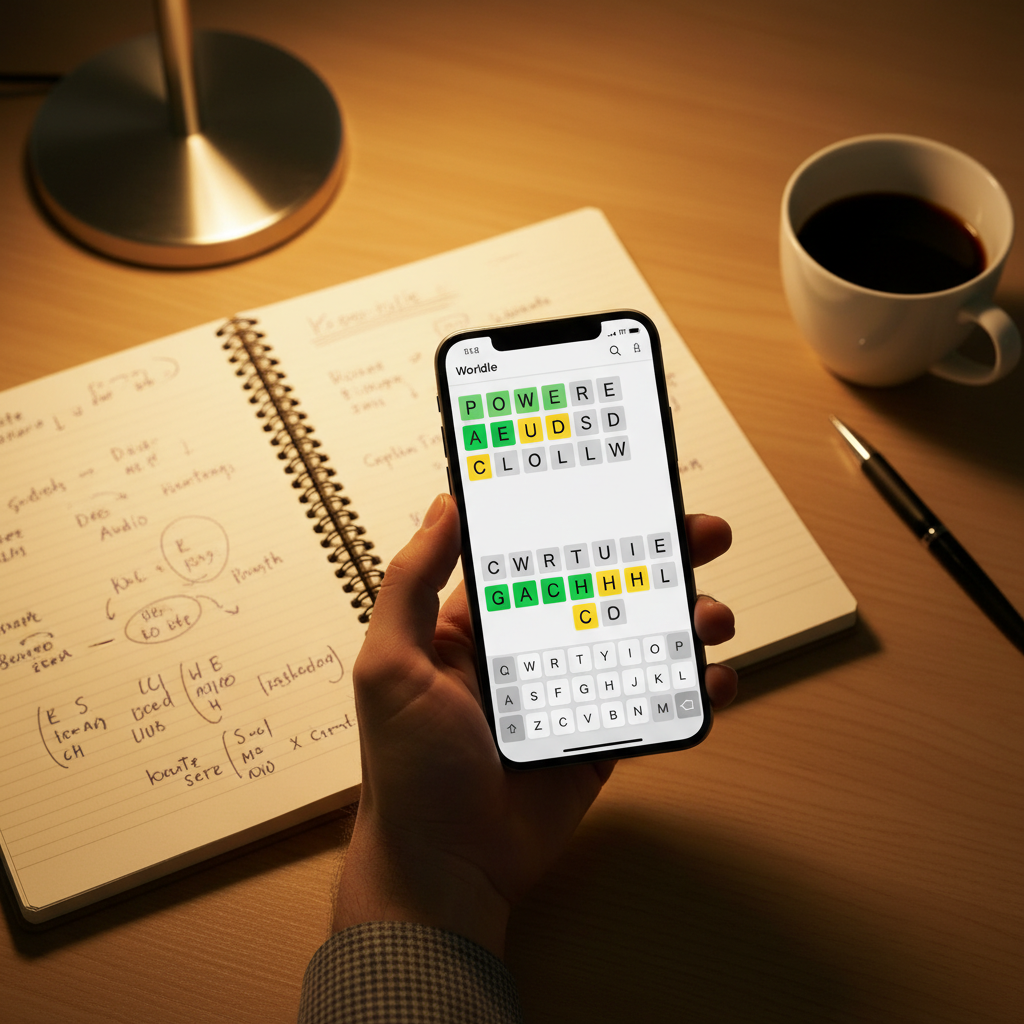
Some players prefer ADIEU as their opening, specifically because it contains four vowels. Plenty of Wordle answers carry two vowels, and ADIEU puts four of them on the board at once, so you learn immediately which ones are in play. However, starting with four vowels sacrifices consonant information, which is why balanced starters like STARE often outperform pure vowel-focused approaches.
The psychological component matters too. Pick an opening word you can execute consistently without overthinking. If you spend 90 seconds deliberating between TRACE and CRANE, you're wasting mental energy that should go toward analyzing your results. Your opening word should become muscle memory, something you type without hesitation so you can focus your cognitive resources on the actual puzzle-solving.
Related: The Best Reality Competition Shows to Watch Right Now, From Survivor to Top Chef
The Case Against Your Personal Favorite Words
Many players start with words they simply like or find comforting, completely ignoring strategic value. This is a surprisingly common mistake among casual players. Plenty of players type the same opening word every single day out of pure habit, whatever the board told them yesterday. Some of these opening words are strategically solid (like STARE), but others are objectively poor choices that handicap their success rates from the very first move.
Reading the Feedback: How to Extract Maximum Information From Your Results
The moment you submit your guess, the game provides visual feedback through colored tiles. This is where the real strategy begins. Many players treat this feedback passively, as though the game is simply telling them whether they won or lost. Actually, every colored tile is a clue that dramatically narrows the possible solutions.
When you see a green tile, that letter is locked in place. When you see yellow, that letter must appear elsewhere in the word. When you see gray, you can eliminate every word containing that letter. This third element is crucial and often underutilized by casual players. If the letter E appears gray in your first guess, you can immediately eliminate every remaining possibility that contains E. That might sound obvious in theory, but in practice, players often forget to systematically cross off eliminated letters when they're thinking through their second guess.
Treat Wordle as a constraint puzzle rather than a guessing game. Every guess either locks a letter in place or removes possibilities, and the players who win consistently are playing to eliminate, not to get lucky.
Let's walk through a concrete example. You start with STARE and get S-green, T-yellow, A-yellow, R-gray, E-yellow. Now you know several things simultaneously: the word starts with S, contains T but not in position two, contains A but not in position three, does not contain R anywhere, and contains E but not in position five. Your next guess should be a word that respects all these constraints while testing new letters. STEAL is actually a phenomenal follow-up here because it keeps S in position one, moves E to position two (different from position five), places T in position three (different from position two), and introduces L as a new letter while testing A in position four.
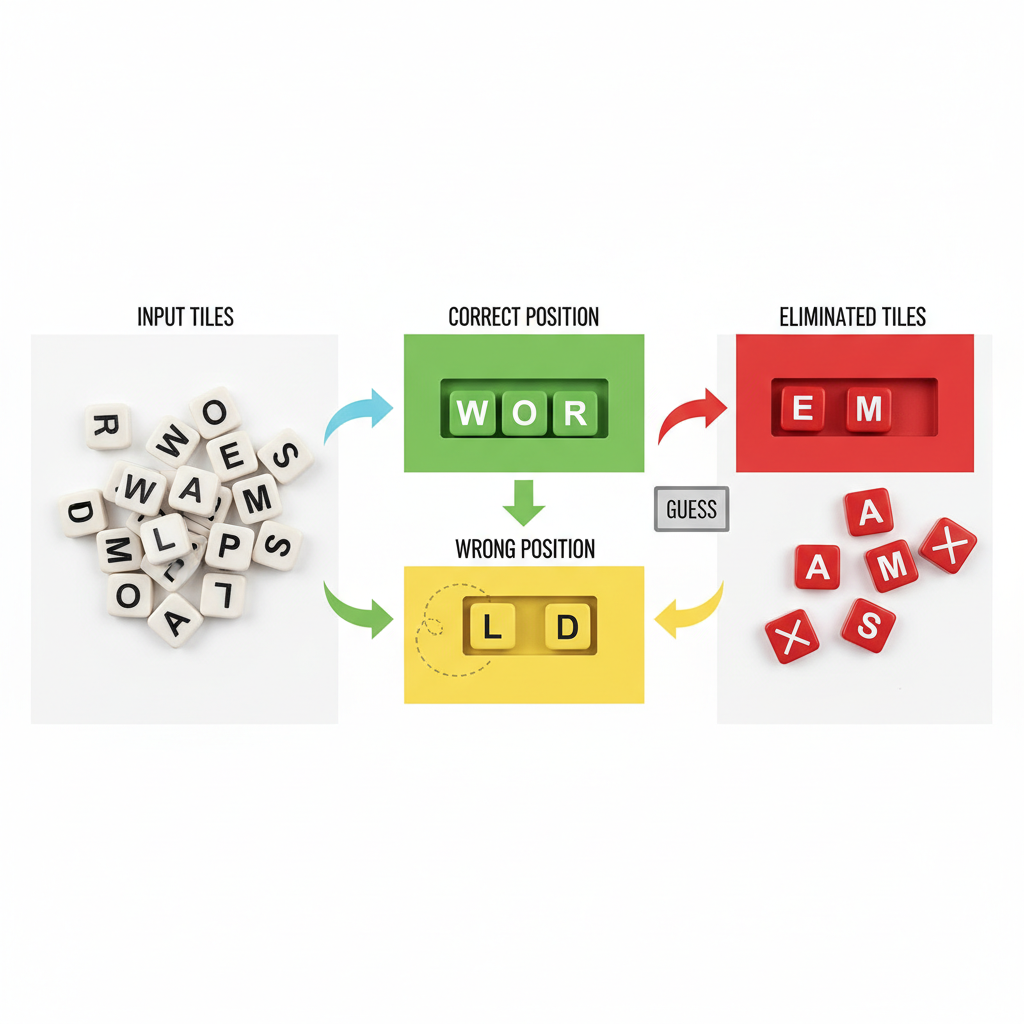
This systematic constraint satisfaction is exactly what separates players who win in three guesses from those who burn through all six attempts. The best players don't guess randomly or go with gut feelings. They methodically eliminate possibilities based on accumulated feedback.
Vowel Management: The Overlooked Element of Wordle Mastery
English words typically contain at least one vowel, often two. Most five-letter words contain some combination of the five main vowels: A, E, I, O, U. Getting your vowel situation sorted out early dramatically improves your odds because once you know which vowels are in the word and where they belong, you can focus your remaining guesses on consonants.
Here's where many players go wrong: they overestimate the frequency of certain vowels. E is the vowel you will meet most often in Wordle answers, and A is not far behind. O, I and U show up noticeably less often. This is why your opening word should definitely include E and A. If your second guess still hasn't turned up any vowels besides E and A, your third guess should aggressively test I, O, and U. Better to confirm vowels early and spend your last few guesses finding consonants than to waste guess four hunting for a vowel that might not even exist in the solution.
Some words are absolute vowel disasters. LYMPH contains zero traditional vowels. NYMPH is similar. While these words do technically appear in Wordle's answer bank occasionally, they're rare enough that you shouldn't optimize your strategy around them. Focus on the high-probability scenario: a word with one or two vowels from the standard set, positioned strategically.
Y as a Wildcard Vowel
Don't forget about Y, which functions as a vowel in words like GYPSY, STYLE, ROYAL, and FIZZY. If you've already tested A, E, I, O, U in various positions and gotten nothing but gray tiles, Y becomes a serious possibility. Incorporating Y into your guesses around move four or five can sometimes rescue what appears to be an unwinnable position.
Common Letter Patterns and Word Structure Recognition
English has recognizable patterns and structures that repeat across different words. Double letters are more common than most players expect, so do not rule them out once the board has narrowed things down. Certain consonant combinations appear frequently: CH, SH, TH, ST, SC, SP, etc. Word endings work differently in Wordle than in everyday English: the answer list leaves out most plurals, so a word ending in S is less likely to be the answer than it looks, while words ending in E or Y turn up all the time.
If you've confirmed that your word has an S somewhere and you're on your fifth guess with limited information, try the S near the start or middle of the word before you try it at the end, because the answer list leaves out most plurals. Similarly, if you've identified the first four letters but haven't found a valid word, checking whether adding a D or E at the end creates a valid word is often faster than trying random consonants.
Josh Wardle specifically designed Wordle to use common, familiar words. He excluded obscure technical terms, proper nouns, and overly complicated vocabulary. This means he's not testing your encyclopedic knowledge of English. He's testing whether you can recognize common word patterns and apply logical constraints. A word like EPOXY is extraordinarily unlikely to appear because most people aren't casually thinking about epoxy on Tuesday morning. A word like PLANT is much more probable.
Learning From Your Losses
When you finally lose a Wordle (and you will), don't just accept the answer and move on. Actually study the answer word. Why didn't you guess it? Were there multiple words that fit your constraints and you guessed wrong? Did you overlook a common pattern? Did you test the wrong letters given the information you had? This reflection takes thirty seconds but dramatically accelerates improvement over time.
Advanced Strategy: Eliminating Multiple Possibilities Simultaneously
Once you understand the fundamentals, you can graduate to a more sophisticated approach. Instead of testing letters you're uncertain about, you can test words that efficiently distinguish between multiple possible solutions. This is the strategy employed by competitive Wordle players and algorithm designers trying to win in minimum guesses.
For example, if your first two guesses have narrowed things down to roughly twenty possible words, your third guess should be strategically chosen to split those twenty possibilities as evenly as possible. Rather than guessing one of the twenty candidates (which might win but gives you no additional information if it's wrong), you guess a word that tests letters present in half the candidates but absent in the other half. This is called information gain optimization, and it's genuinely powerful.
Most casual players will never need this level of sophistication to win consistently. But if you're trying to crack the daily puzzle in two guesses or you're genuinely fascinated by the game's strategy layer, this approach separates recreational play from serious puzzle-solving. Websites like Wordle Solver provide analysis of optimal strategies based on information theory, and watching how these solvers approach each puzzle reveals patterns you can apply to your own play.
Tactical Mistakes That Sabotage Even Good Players
Knowledge of strategy only helps if you actually execute it consistently. Several tactical errors appear again and again among players who understand the fundamentals but fail to apply them.
The Premature Victory Guess
You get three letters confirmed and suddenly you're certain about the answer. You guess it even though you haven't fully tested the vowel situation. Sometimes this works, but sometimes you're confidently wrong. Patience matters. You only lose one point in your stats for using six guesses versus five. You lose nothing for being methodical.
Ignoring Confirmed Constraints
You've determined that A is in the word and R is not. Then on your next guess, you test a word without A or you include R. This sounds absurd written out, but it happens constantly under time pressure. Before submitting each guess, spend five seconds verifying that it actually respects all known constraints.
Testing Letters You've Already Eliminated
If the E turned gray in your first guess, there is zero value in testing another word with E unless you have a very specific strategic reason (which is rare). Similarly, once you've confirmed T is in the word and found a green T somewhere, stop testing T in other positions unless absolutely necessary. Every guess should test new information.
Training Your Intuition: Becoming a Consistent Winner
After you've won Wordle twenty or thirty times using strategic principles, something interesting happens. You stop consciously thinking through the strategy. You've internalized the letter frequencies, pattern recognition, and constraint satisfaction. Your intuition becomes reliable because it's built on actual principles rather than random guessing.
This is exactly what separates players who win almost every day from players who scrape through on their final guess. Most of those people aren't actively running probability calculations in their heads. They've simply trained their intuition through repeated strategic play.
Your path to consistent three-guess victories involves roughly five stages: first, learn the fundamentals and deliberately apply them. Second, play daily and maintain a small notebook of interesting words and patterns you encounter. Third, analyze your losses and identify where your strategy faltered. Fourth, internalize the patterns until you stop actively thinking about strategy. Fifth, maintain consistency even on days when you're tired or distracted, because one careless guess can turn a winnable puzzle into a loss.
The Bigger Picture: What Wordle Says About Problem-Solving
Wordle's explosive popularity reveals something important about human psychology. We're drawn to constrained problems with clear rules, immediate feedback, and elegant solutions. The game succeeds not because it's complicated but because it's perfectly calibrated: difficult enough to feel satisfying when solved, simple enough to access regardless of skill level, and designed to respect the player's time.
The strategies outlined here work because they apply fundamental problem-solving principles: gather information before deciding, eliminate impossibilities systematically, recognize patterns, and optimize for efficiency. These principles extend far beyond Wordle into actual professional problem-solving, decision-making, and analytical work. The game becomes interesting not just as entertainment but as a training ground for intellectual discipline.
Your journey toward three-guess consistency isn't just about winning a word game. It's about developing the mental habits that make you systematically better at any constraint-based puzzle or problem. Start with your opening word strategy today, maintain a consistent approach, and watch how quickly you internalize the patterns that separate casual players from the consistently victorious.